St. Schumi
An2025
Tehnicăacrylic on canvas, mixed media
Dimensiuni160 x 200 cm
12 000 EUR - link de platǎ disponibil la finalul prezentǎrii (payment link available at the end of presentation)
RO/EN:
Michael Schumacher a câștigat șapte titluri mondiale, nouăzeci și unu de Mari Premii și a primit la schimb o nemurire stranie: de peste treisprezece ani zace într-o stare pe care familia refuză s-o numească și pe care presa a învățat s-o ocolească, într-un castel elvețian transformat în unitate de terapie intensivă unde costurile se ridică la zeci de milioane de euro pe an, bani care vin în continuare din gestiunea averii sale colosale acumulatǎ ca sportiv, cǎci starea lui Schumacher e o virgulă care durează de peste un deceniu.
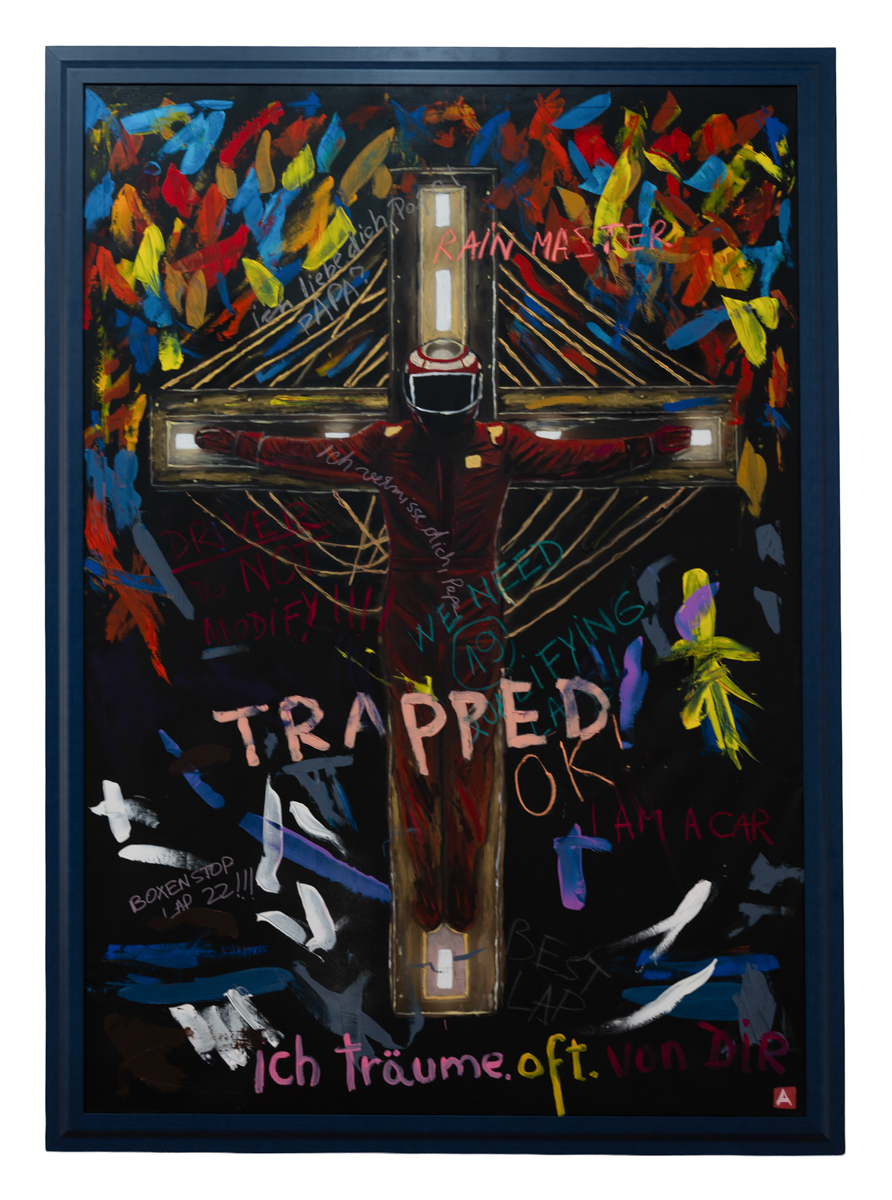
Tabloul îl arată crucificat în propria salopetă de pilot, pe o cruce ca un pit lane, cu luminile de semnalizare acolo unde ar fi fost piroanele, iar asta nu e o metaforă — e o descriere literală a ceea ce se întâmplă: un om ținut fixat într-un cadru pe care alții îl controlează, cu corpul expus, dar invizibil, cu brațele deschise într-un gest care seamănă cu victoria dar e, de fapt, imobilitate totală.
Sus, deasupra crucii, cerul e plin de confetti — petale de podium în culorile circuitelor, roșu de Ferrari, albastru de Benetton, explozia de culoare care însoțea fiecare victorie, artificiile ceremoniei care l-au făcut zeu. Confetti-urile sunt autentice, sunt reale, aparțin unei biografii care chiar a existat. Dar pe măsură ce cobori în tablou, culorile se împrăștie haotic, se sparg, devin gesturi nervoase, tușe care nu mai celebrează nimic, ci doar agită suprafața întunericului interior, și ajungi jos, unde tabloul se transformă într-o cameră de ecou a unui creier captiv.
Textele scrise pe suprafața lucrării sunt vocile care îl traversează zi de zi pe Schumacher — aşa îmi imaginez eu. „TRAPPED" e cuvântul cel mai mare și cel mai vizibil, pentru că e singurul adevăr nenegociabil. „DRIVER DO NOT MODIFY!!!" e un mesaj standard de inginerie din Formula 1, instrucțiunea pe care echipa o dă pilotului când nu are voie să schimbe setările mașinii, și care aici devine porunca unei familii care a decis că nimic nu se schimbă, că starea de fapt a lui Michael e permanentă, că decizia de a-l ține în viață nu se rediscută niciodată. „I AM A CAR" e poate cel mai dureros text din tablou — e vocea unui om care și-a petrecut viața contopindu-se cu mașina până când diferența dintre pilot și vehicul a dispărut complet, iar acum, când corpul lui a devenit un vehicul fără pilot, fraza se întoarce ca un blestem.
„Ich liebe dich, Papa" e scris sus, lângă confetti, cu roz — e vocea Ginei, a fiicei, care conform relatărilor îi vorbește tatălui ei în fiecare zi, îi spune la mulți ani, îi povestește despre viața ei, fără să știe dacă el aude, fără să știe dacă tăcerea din fața ei e liniște sau prăbușire. „Ich vermisse dich" — îmi e dor de tine — e scris mai mic, aproape acoperit, pentru că e tipul de durere care nu se strigă. „Ich träume oft von Dir" — visez des la tine — e scris jos de tot, cu galben pe negru, și e singura propoziție care ar putea veni din interiorul lui, dacă interiorul lui mai produce propoziții, dacă undeva în creierul acela care a procesat viteze de trei sute de kilometri pe oră mai există o sinapsǎ care visează, și dacă visează, la cine visează — la familie, la circuit, la zăpada care l-a oprit din a trǎi omeneşte.
„Rain Master" e titlul pe care i l-au dat fanii pentru cursele din ploaie, pentru capacitatea lui supranaturală de a controla o mașină pe apă, iar aici stă scris deasupra crucii ca un titlu de sfânt — St. Schumi, patronul vitezei în condiții imposibile, sfântul care a învins ploaia, dar n-a învins gheața de pe pârtia de ski. „Boxenstop Lap 22!!!" și „Best Lap" sunt strigătele inginerilor de pistă, fragmentele de comunicație radio care încă răsună undeva în memoria musculară a unui corp care nu se mai mișcă, vocile care îi spuneau când să intre, când să iasă, când să accelereze, și care acum nu-i mai spun nimic pentru că nu mai e nimic de spus.
Tabloul meu nu judecă familia Schumacher, dar nici nu îi absolvă — ce face pânza mea e mai rău decât ambele: pune întrebarea grea, și anume dacă există un punct în care dragostea devine custodie, în care grija devine control, în care refuzul de a lăsa pe cineva să moară devine refuzul de a-l lăsa să fie altceva decât ce a fost.
Michael Schumacher e ținut în viață nu pentru că trăiește, ci pentru că moartea lui ar fi un eveniment cu consecințe financiare, juridice și emoționale pe care nimeni din jurul lui nu e pregătit să le gestioneze. Și atâta timp cât inima lui bate, el rămâne pe cruce, cu luminile aprinse, cu casca pe cap, cu brațele deschise, într-un pit stop care nu se mai termină.
---------------
Michael Schumacher won seven world titles, ninety-one Grands Prix, and in return received a strange kind of immortality: for more than thirteen years he has been lying in a state his family refuses to name and the press has learned to circle around, in a Swiss castle turned into an intensive care unit where the costs reach tens of millions of euros per year — money that still comes from the management of his colossal fortune accumulated as an athlete, because Schumacher’s condition is a comma that has lasted for more than a decade.
The painting shows him crucified in his own racing suit, on a cross shaped like a pit lane, with signal lights where the nails would have been — and this is not a metaphor, it’s a literal description of what is happening: a man held fixed inside a frame controlled by others, with his body exposed yet invisible, with his arms open in a gesture that resembles victory but is, in fact, total immobility.
Above, over the cross, the sky is full of confetti — podium petals in the colors of the circuits, Ferrari red, Benetton blue, the explosion of color that accompanied each victory, the ceremonial fireworks that made him a god. The confetti is authentic, real, belonging to a biography that truly existed. But as you descend in the painting, the colors scatter chaotically, they break apart, turning into nervous strokes, gestures that celebrate nothing anymore but only agitate the surface of an inner darkness, until you reach the bottom, where the painting becomes an echo chamber of a captive brain.
The texts written across the surface are the voices that pass through Schumacher day after day — or so I imagine. “TRAPPED” is the largest, most visible word because it is the only non-negotiable truth. “DRIVER DO NOT MODIFY!!!” is a standard engineering message from Formula 1, the instruction given to the driver when he is not allowed to change the car’s settings, and here it becomes the command of a family that has decided nothing changes, that Michael’s state is permanent, that the decision to keep him alive is never to be revisited. “I AM A CAR” is perhaps the most painful text on the canvas — the voice of a man who spent his life merging with the machine until the difference between driver and vehicle disappeared completely, and now, when his body has become a vehicle without a driver, the phrase returns like a curse.
“Ich liebe dich, Papa” is written at the top, near the confetti, in pink — the voice of Gina, the daughter, who according to reports speaks to her father every day, wishes him happy birthday, tells him about her life, without knowing whether he hears, without knowing whether the silence before her is peace or collapse. “Ich vermisse dich” — I miss you — is written smaller, nearly covered, because it is the kind of pain that is not shouted. “Ich träume oft von Dir” — I often dream of you — is written at the very bottom, yellow on black, and it is the only sentence that could come from inside him, if that interior still produces sentences, if somewhere in that brain that once processed speeds of three hundred kilometers per hour there still exists a synapse that dreams, and if it dreams, who it dreams of — family, the racetrack, or the snow that stopped him from living as a human being.
“Rain Master” is the title fans gave him for his races in the rain, for his supernatural ability to control a car on water, and here it stands above the cross like a saint’s title — St. Schumi, patron saint of speed in impossible conditions, the saint who conquered the rain but did not conquer the ice on a ski slope. “Boxenstop Lap 22!!!” and “Best Lap” are the cries of race engineers, fragments of radio communication that still echo somewhere in the muscle memory of a body that no longer moves, the voices that once told him when to enter, when to exit, when to accelerate — and that now tell him nothing because there is nothing left to say.
My painting does not judge the Schumacher family, but neither does it absolve them — what the canvas does is worse than both: it asks the hard question, namely whether there is a point at which love becomes custody, at which care becomes control, at which the refusal to let someone die becomes a refusal to let them be anything other than what they once were.
Michael Schumacher is kept alive not because he lives, but because his death would be an event with financial, legal, and emotional consequences no one around him is prepared to handle. And as long as his heart keeps beating, he remains on the cross, with the lights on, with the helmet on, with his arms open, in a pit stop that never ends.
RO/EN:
Michael Schumacher a câștigat șapte titluri mondiale, nouăzeci și unu de Mari Premii și a primit la schimb o nemurire stranie: de peste treisprezece ani zace într-o stare pe care familia refuză s-o numească și pe care presa a învățat s-o ocolească, într-un castel elvețian transformat în unitate de terapie intensivă unde costurile se ridică la zeci de milioane de euro pe an, bani care vin în continuare din gestiunea averii sale colosale acumulatǎ ca sportiv, cǎci starea lui Schumacher e o virgulă care durează de peste un deceniu.
Tabloul îl arată crucificat în propria salopetă de pilot, pe o cruce ca un pit lane, cu luminile de semnalizare acolo unde ar fi fost piroanele, iar asta nu e o metaforă — e o descriere literală a ceea ce se întâmplă: un om ținut fixat într-un cadru pe care alții îl controlează, cu corpul expus, dar invizibil, cu brațele deschise într-un gest care seamănă cu victoria dar e, de fapt, imobilitate totală.
Sus, deasupra crucii, cerul e plin de confetti — petale de podium în culorile circuitelor, roșu de Ferrari, albastru de Benetton, explozia de culoare care însoțea fiecare victorie, artificiile ceremoniei care l-au făcut zeu. Confetti-urile sunt autentice, sunt reale, aparțin unei biografii care chiar a existat. Dar pe măsură ce cobori în tablou, culorile se împrăștie haotic, se sparg, devin gesturi nervoase, tușe care nu mai celebrează nimic, ci doar agită suprafața întunericului interior, și ajungi jos, unde tabloul se transformă într-o cameră de ecou a unui creier captiv.
Textele scrise pe suprafața lucrării sunt vocile care îl traversează zi de zi pe Schumacher — aşa îmi imaginez eu. „TRAPPED" e cuvântul cel mai mare și cel mai vizibil, pentru că e singurul adevăr nenegociabil. „DRIVER DO NOT MODIFY!!!" e un mesaj standard de inginerie din Formula 1, instrucțiunea pe care echipa o dă pilotului când nu are voie să schimbe setările mașinii, și care aici devine porunca unei familii care a decis că nimic nu se schimbă, că starea de fapt a lui Michael e permanentă, că decizia de a-l ține în viață nu se rediscută niciodată. „I AM A CAR" e poate cel mai dureros text din tablou — e vocea unui om care și-a petrecut viața contopindu-se cu mașina până când diferența dintre pilot și vehicul a dispărut complet, iar acum, când corpul lui a devenit un vehicul fără pilot, fraza se întoarce ca un blestem.
„Ich liebe dich, Papa" e scris sus, lângă confetti, cu roz — e vocea Ginei, a fiicei, care conform relatărilor îi vorbește tatălui ei în fiecare zi, îi spune la mulți ani, îi povestește despre viața ei, fără să știe dacă el aude, fără să știe dacă tăcerea din fața ei e liniște sau prăbușire. „Ich vermisse dich" — îmi e dor de tine — e scris mai mic, aproape acoperit, pentru că e tipul de durere care nu se strigă. „Ich träume oft von Dir" — visez des la tine — e scris jos de tot, cu galben pe negru, și e singura propoziție care ar putea veni din interiorul lui, dacă interiorul lui mai produce propoziții, dacă undeva în creierul acela care a procesat viteze de trei sute de kilometri pe oră mai există o sinapsǎ care visează, și dacă visează, la cine visează — la familie, la circuit, la zăpada care l-a oprit din a trǎi omeneşte.
„Rain Master" e titlul pe care i l-au dat fanii pentru cursele din ploaie, pentru capacitatea lui supranaturală de a controla o mașină pe apă, iar aici stă scris deasupra crucii ca un titlu de sfânt — St. Schumi, patronul vitezei în condiții imposibile, sfântul care a învins ploaia, dar n-a învins gheața de pe pârtia de ski. „Boxenstop Lap 22!!!" și „Best Lap" sunt strigătele inginerilor de pistă, fragmentele de comunicație radio care încă răsună undeva în memoria musculară a unui corp care nu se mai mișcă, vocile care îi spuneau când să intre, când să iasă, când să accelereze, și care acum nu-i mai spun nimic pentru că nu mai e nimic de spus.
Tabloul meu nu judecă familia Schumacher, dar nici nu îi absolvă — ce face pânza mea e mai rău decât ambele: pune întrebarea grea, și anume dacă există un punct în care dragostea devine custodie, în care grija devine control, în care refuzul de a lăsa pe cineva să moară devine refuzul de a-l lăsa să fie altceva decât ce a fost.
Michael Schumacher e ținut în viață nu pentru că trăiește, ci pentru că moartea lui ar fi un eveniment cu consecințe financiare, juridice și emoționale pe care nimeni din jurul lui nu e pregătit să le gestioneze. Și atâta timp cât inima lui bate, el rămâne pe cruce, cu luminile aprinse, cu casca pe cap, cu brațele deschise, într-un pit stop care nu se mai termină.
---------------
Michael Schumacher won seven world titles, ninety-one Grands Prix, and in return received a strange kind of immortality: for more than thirteen years he has been lying in a state his family refuses to name and the press has learned to circle around, in a Swiss castle turned into an intensive care unit where the costs reach tens of millions of euros per year — money that still comes from the management of his colossal fortune accumulated as an athlete, because Schumacher’s condition is a comma that has lasted for more than a decade.
The painting shows him crucified in his own racing suit, on a cross shaped like a pit lane, with signal lights where the nails would have been — and this is not a metaphor, it’s a literal description of what is happening: a man held fixed inside a frame controlled by others, with his body exposed yet invisible, with his arms open in a gesture that resembles victory but is, in fact, total immobility.
Above, over the cross, the sky is full of confetti — podium petals in the colors of the circuits, Ferrari red, Benetton blue, the explosion of color that accompanied each victory, the ceremonial fireworks that made him a god. The confetti is authentic, real, belonging to a biography that truly existed. But as you descend in the painting, the colors scatter chaotically, they break apart, turning into nervous strokes, gestures that celebrate nothing anymore but only agitate the surface of an inner darkness, until you reach the bottom, where the painting becomes an echo chamber of a captive brain.
The texts written across the surface are the voices that pass through Schumacher day after day — or so I imagine. “TRAPPED” is the largest, most visible word because it is the only non-negotiable truth. “DRIVER DO NOT MODIFY!!!” is a standard engineering message from Formula 1, the instruction given to the driver when he is not allowed to change the car’s settings, and here it becomes the command of a family that has decided nothing changes, that Michael’s state is permanent, that the decision to keep him alive is never to be revisited. “I AM A CAR” is perhaps the most painful text on the canvas — the voice of a man who spent his life merging with the machine until the difference between driver and vehicle disappeared completely, and now, when his body has become a vehicle without a driver, the phrase returns like a curse.
“Ich liebe dich, Papa” is written at the top, near the confetti, in pink — the voice of Gina, the daughter, who according to reports speaks to her father every day, wishes him happy birthday, tells him about her life, without knowing whether he hears, without knowing whether the silence before her is peace or collapse. “Ich vermisse dich” — I miss you — is written smaller, nearly covered, because it is the kind of pain that is not shouted. “Ich träume oft von Dir” — I often dream of you — is written at the very bottom, yellow on black, and it is the only sentence that could come from inside him, if that interior still produces sentences, if somewhere in that brain that once processed speeds of three hundred kilometers per hour there still exists a synapse that dreams, and if it dreams, who it dreams of — family, the racetrack, or the snow that stopped him from living as a human being.
“Rain Master” is the title fans gave him for his races in the rain, for his supernatural ability to control a car on water, and here it stands above the cross like a saint’s title — St. Schumi, patron saint of speed in impossible conditions, the saint who conquered the rain but did not conquer the ice on a ski slope. “Boxenstop Lap 22!!!” and “Best Lap” are the cries of race engineers, fragments of radio communication that still echo somewhere in the muscle memory of a body that no longer moves, the voices that once told him when to enter, when to exit, when to accelerate — and that now tell him nothing because there is nothing left to say.
My painting does not judge the Schumacher family, but neither does it absolve them — what the canvas does is worse than both: it asks the hard question, namely whether there is a point at which love becomes custody, at which care becomes control, at which the refusal to let someone die becomes a refusal to let them be anything other than what they once were.
Michael Schumacher is kept alive not because he lives, but because his death would be an event with financial, legal, and emotional consequences no one around him is prepared to handle. And as long as his heart keeps beating, he remains on the cross, with the lights on, with the helmet on, with his arms open, in a pit stop that never ends.
12.000 €
Cumpără