New show in town: LIVE angelification
An2025
Tehnicăacrylic on canvas, mixed media
Dimensiuni140 x 100 cm
7 000 EUR - link de platǎ disponibil la finalul prezentǎrii (payment link available at the end of presentation)
RO/EN
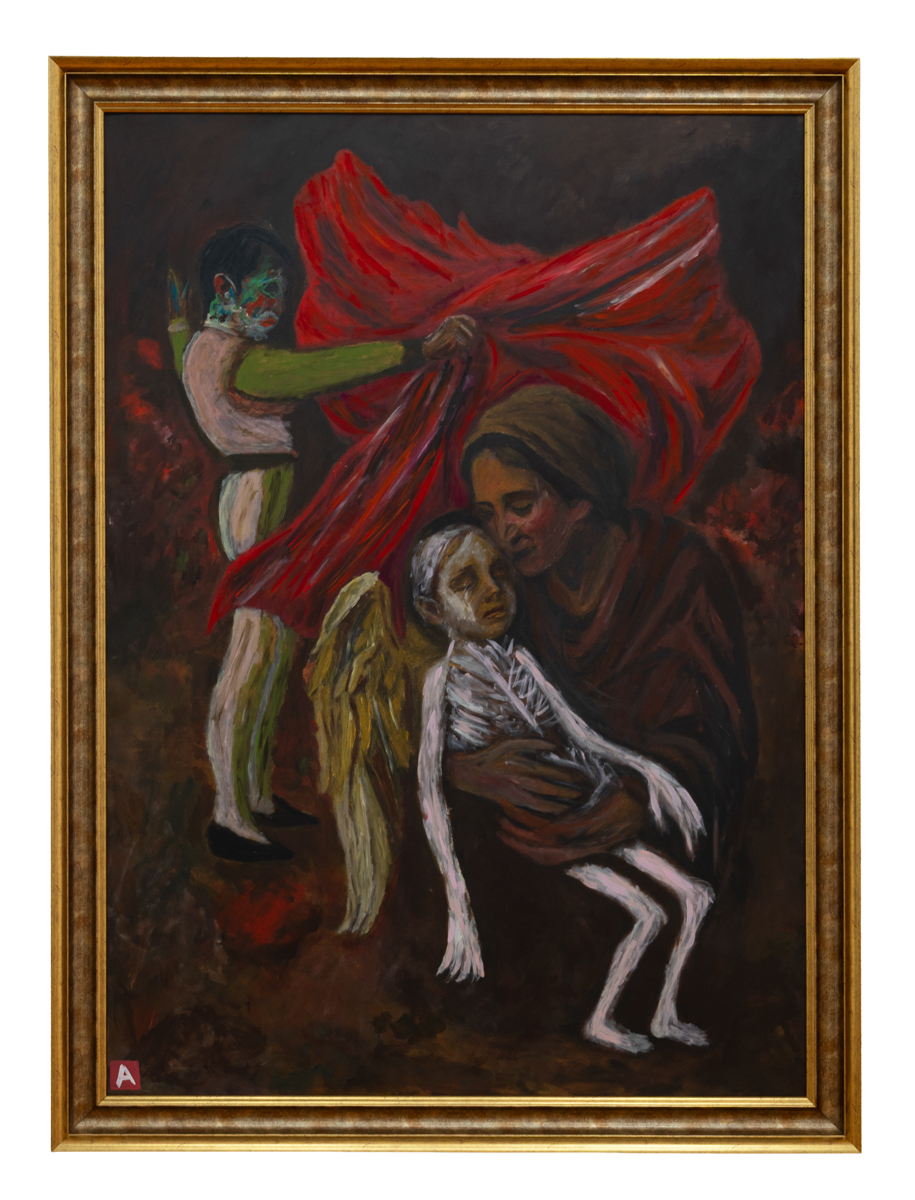
Un toreador cu față de Joker aruncǎ mantia roșie peste o scenă tristǎ ca sǎ o acopere, oricum, o scenǎ pe care nu nici nu vrem s-o vedem, fiindcǎ asta e lumea de azi — cineva face spectacol sau zgomot ca sǎ ne distragǎ de la faptul cǎ un copil moare ucis de gloanțe și între cele două lucruri nu există nicio contradicție, pentru că am construit din suferința altora motivul perfect pentru a alunga plictiseala, prin telefoanele din care citim despre tragedii, dar doar treizeci de secunde dupǎ care ne uitǎm la un filmuleț cu pisici amuzante.
Mantia roșie e cea mai veche iluzie din istoria spectacolului: toreadorul nu învinge cu ea taurul, doar îi deturnează privirea, îl face să atace în altă parte, să se epuizeze lovind în gol în timp ce adevărata amenințare e în spatele pânzei. Exact asta facem cu tot ce se întâmplă în Gaza, Congo, în Yemen, în Sudan, în Myanmar, — agităm mantia compasiunii publice, a hashtag-urilor, dar... atât.
Copilul din brațele femeii e cadaveric, emaciat, cu aripi galbene ofilite care nu l-au dus nicăieri, pentru că „angelificarea" e un proces care se aplică doar post-mortem și doar în beneficiul celor care privesc — transformăm victimele în îngeri nu ca să le onorăm memoria, ci ca să ne ușurăm conștiința, pentru că un înger e deja în cer, deja salvat, deja în afara responsabilității noastre, și atunci putem să trecem la următorul subiect fără remușcări.
Suferința a devenit un spectacol, o nouǎ catastrofă e doar un episod nou dintr-un "serial" pe care îl urmărim cu detașare, iar „LIVE Angelification" e procesul prin care transformăm în timp real oamenii morți în simboluri suportabile, în conținut digerabil, în povești cu final deschis care ne permit să credem că totul are sens atâta timp cât cineva, undeva, ajunge în cer. Tabloul meu spune că nu ajunge nimeni în cer. Și că noi suntem și toreadorul, și publicul, și taurul.
----------------------------
A toreador with the face of the Joker throws his red cape over a sorrowful scene to cover it — a scene we wouldn’t want to look at anyway, because this is the world today: someone makes noise or spectacle to distract us from the fact that a child is dying, shot to pieces, and between these two realities there is no contradiction at all. We have turned the suffering of others into the perfect antidote to boredom — we read about tragedies on our phones for thirty seconds, and then we scroll to a funny cat video.
The red cape is the oldest illusion in the history of spectacle: the toreador doesn’t defeat the bull with it, he simply diverts its gaze, makes it charge elsewhere, makes it exhaust itself striking at nothing while the real danger stands behind the cloth. This is exactly what we do with everything happening in Gaza, in Congo, in Yemen, in Sudan, in Myanmar — we shake the cape of public compassion, of hashtags, and… that’s it.
The child in the woman’s arms is cadaveric, emaciated, with wilted yellow wings that carried him nowhere, because “angelification” is a process applied only post-mortem and only for the comfort of those who watch. We turn victims into angels not to honor their memory, but to soothe our own conscience, because an angel is already in heaven, already safe, already beyond our responsibility — and that lets us move on to the next headline without guilt.
Suffering has become a spectacle; each new catastrophe is just another episode of a “series” we watch with detachment. And “LIVE Angelification” is the process by which we turn the dead, in real time, into symbols that are bearable, digestible, curated into stories with an open ending that allow us to believe everything has meaning as long as someone, somewhere, ends up in heaven.
My painting says no one gets to heaven.
And that we are the toreador, the audience, and the bull all at once.
RO/EN
Un toreador cu față de Joker aruncǎ mantia roșie peste o scenă tristǎ ca sǎ o acopere, oricum, o scenǎ pe care nu nici nu vrem s-o vedem, fiindcǎ asta e lumea de azi — cineva face spectacol sau zgomot ca sǎ ne distragǎ de la faptul cǎ un copil moare ucis de gloanțe și între cele două lucruri nu există nicio contradicție, pentru că am construit din suferința altora motivul perfect pentru a alunga plictiseala, prin telefoanele din care citim despre tragedii, dar doar treizeci de secunde dupǎ care ne uitǎm la un filmuleț cu pisici amuzante.
Mantia roșie e cea mai veche iluzie din istoria spectacolului: toreadorul nu învinge cu ea taurul, doar îi deturnează privirea, îl face să atace în altă parte, să se epuizeze lovind în gol în timp ce adevărata amenințare e în spatele pânzei. Exact asta facem cu tot ce se întâmplă în Gaza, Congo, în Yemen, în Sudan, în Myanmar, — agităm mantia compasiunii publice, a hashtag-urilor, dar... atât.
Copilul din brațele femeii e cadaveric, emaciat, cu aripi galbene ofilite care nu l-au dus nicăieri, pentru că „angelificarea" e un proces care se aplică doar post-mortem și doar în beneficiul celor care privesc — transformăm victimele în îngeri nu ca să le onorăm memoria, ci ca să ne ușurăm conștiința, pentru că un înger e deja în cer, deja salvat, deja în afara responsabilității noastre, și atunci putem să trecem la următorul subiect fără remușcări.
Suferința a devenit un spectacol, o nouǎ catastrofă e doar un episod nou dintr-un "serial" pe care îl urmărim cu detașare, iar „LIVE Angelification" e procesul prin care transformăm în timp real oamenii morți în simboluri suportabile, în conținut digerabil, în povești cu final deschis care ne permit să credem că totul are sens atâta timp cât cineva, undeva, ajunge în cer. Tabloul meu spune că nu ajunge nimeni în cer. Și că noi suntem și toreadorul, și publicul, și taurul.
----------------------------
A toreador with the face of the Joker throws his red cape over a sorrowful scene to cover it — a scene we wouldn’t want to look at anyway, because this is the world today: someone makes noise or spectacle to distract us from the fact that a child is dying, shot to pieces, and between these two realities there is no contradiction at all. We have turned the suffering of others into the perfect antidote to boredom — we read about tragedies on our phones for thirty seconds, and then we scroll to a funny cat video.
The red cape is the oldest illusion in the history of spectacle: the toreador doesn’t defeat the bull with it, he simply diverts its gaze, makes it charge elsewhere, makes it exhaust itself striking at nothing while the real danger stands behind the cloth. This is exactly what we do with everything happening in Gaza, in Congo, in Yemen, in Sudan, in Myanmar — we shake the cape of public compassion, of hashtags, and… that’s it.
The child in the woman’s arms is cadaveric, emaciated, with wilted yellow wings that carried him nowhere, because “angelification” is a process applied only post-mortem and only for the comfort of those who watch. We turn victims into angels not to honor their memory, but to soothe our own conscience, because an angel is already in heaven, already safe, already beyond our responsibility — and that lets us move on to the next headline without guilt.
Suffering has become a spectacle; each new catastrophe is just another episode of a “series” we watch with detachment. And “LIVE Angelification” is the process by which we turn the dead, in real time, into symbols that are bearable, digestible, curated into stories with an open ending that allow us to believe everything has meaning as long as someone, somewhere, ends up in heaven.
My painting says no one gets to heaven.
And that we are the toreador, the audience, and the bull all at once.
Vândut